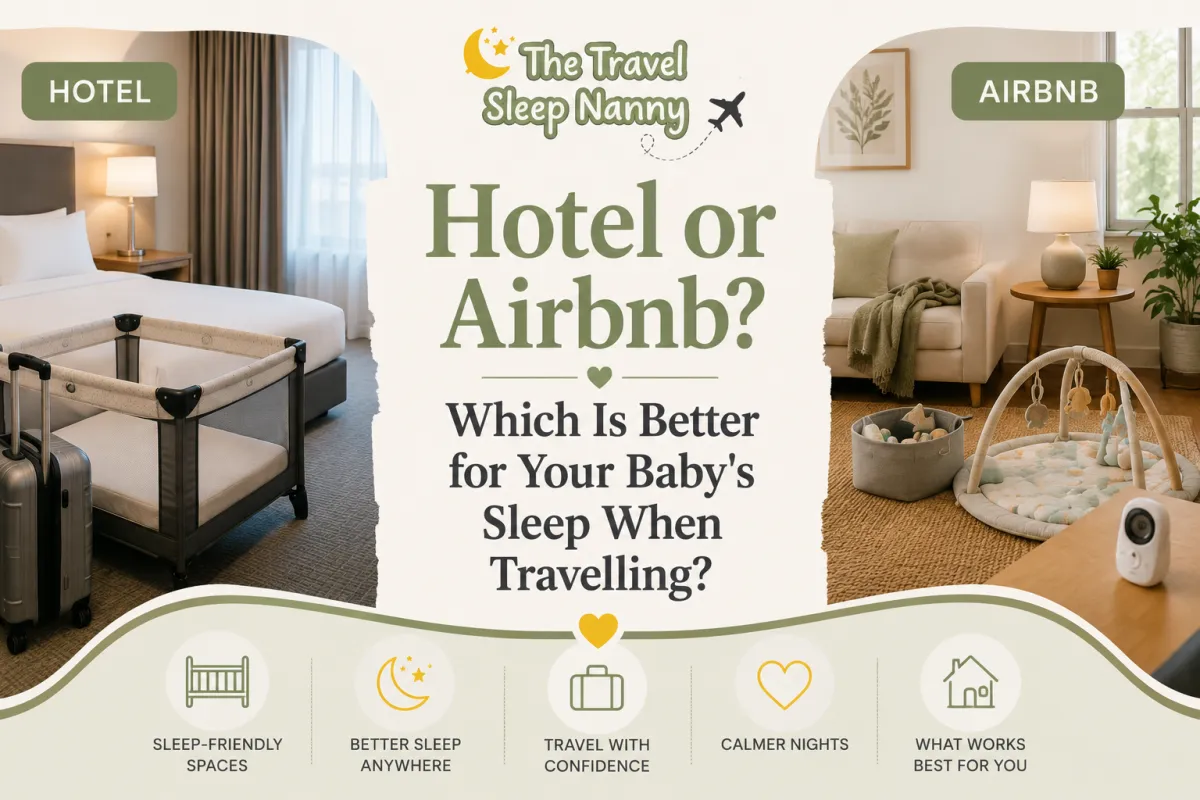
Hotel or Airbnb? Which Is Better for Your Baby's Sleep When Travelling?

A spacious hotel room with two travel cots, giving families flexibility while travelling.
Hotel vs Airbnb – Which Is Better for Your Baby's Sleep?
One of the questions I get asked the most is:
"Should we book a hotel or an Airbnb if we want our baby to sleep well?"
The truth is, there isn't one right answer. Every family is different, every baby is different, and
every trip has different priorities.
However, after travelling with families for years as both a travel nanny and sleep consultant, I've
noticed some clear patterns. Sometimes the perfect-looking hotel can lead to terrible nights,
while a simple Airbnb can feel just like home.
Here's what I always consider before booking.
1. Blackout Curtains Can Make or Break Sleep
This is probably my number one priority.
Many hotel websites proudly advertise "blackout curtains" but unfortunately they don't always
block much light. Tiny gaps around the edges can leave the room surprisingly bright at bedtime
or during early morning wake-ups.
Airbnbs can be even more unpredictable. Some have fantastic shutters or thick curtains, while
others have little more than sheer blinds.
Before booking, I always recommend looking carefully through guest photos and reviews. If
blackout isn't guaranteed, pack a portable blackout blind. It's lightweight, reusable and can
completely transform sleep in an unfamiliar room.
A dark sleep environment helps babies fall asleep more easily and reduces those frustrating 5:30
a.m. wake-ups while you're trying to enjoy your holiday.
2. Think About Noise—Inside and Outside
Hotels often have excellent soundproofing, but they also come with plenty of unexpected noise.
You might hear doors slamming in the corridor, people chatting late at night, lifts opening
nearby or housekeeping starting early in the morning.
Airbnbs are usually quieter inside but can be noisier outside depending on the location. Busy
roads, restaurants underneath or neighbouring apartments can all affect sleep.
Wherever you're staying, I always travel with a white noise machine. It becomes a familiar sleep
cue and helps block unpredictable sounds, making new environments feel much more familiar
for little ones.
3. Room Sharing Isn't Always Easy
Many parents assume they'll simply put the travel cot next to their bed and everyone will sleep
happily.
Sometimes that works beautifully.
Other times, your baby can see you every time they stir and suddenly wants to play, feed or be
cuddled throughout the night.
One of my favourite hotel room layouts is a room with a small entrance hallway or dressing area
where the travel cot can fit. Even a partial visual separation can make a huge difference.
This is actually where Airbnbs often win. Having a separate bedroom means parents can relax in
the evening without sitting silently in the dark from 7 p.m. onwards.
Your holiday should feel like a holiday too.
4. Don't Assume the Travel Cot Will Be Comfortable About Noise—Inside and Outside
Both hotels and Airbnbs often advertise a travel cot, but they vary enormously.
Some are modern, clean and comfortable.
Others have very thin mattresses, loose sides or have clearly seen better days.
If your baby has never slept in a travel cot before, don't let holiday be the first time they try it.
Practise at home for a few naps or overnight sleeps so it feels familiar before you travel.
Bringing your baby's own fitted sheet or sleep sack also adds another comforting piece of home.
5. Apartments vs Hotels—Which Wins?
For short city breaks of one or two nights, I often recommend hotels.
They're convenient, usually offer daily cleaning and you don't need to think about cooking or
tidying.
For longer holidays, Airbnbs usually become much easier.
Having a kitchen means you can prepare familiar meals, wash bottles more easily and stick to
your normal routine. A washing machine is another huge bonus that many parents don't
appreciate until they need it.
Extra living space also means everyone gets a little breathing room during naps or early
bedtimes.
If you're travelling with toddlers, that space can be invaluable.

One of my favourite room layouts—a separate living area allows parents to relax while baby
sleeps undisturbed.
My Favourite Sleep-Friendly Room Layouts
A bedroom with a separate living area.
A hotel suite rather than a standard room.
An apartment with two sleeping spaces.
A room with an entrance hallway large enough for the travel cot.
A balcony or terrace where parents can relax after bedtime while staying within monitor
range.
My Final Thoughts
Parents often spend hours comparing pools, breakfast buffets and locations—but forget to think
about where their baby will actually sleep.
A well-rested baby usually means well-rested parents, happier days exploring and a far more
enjoyable holiday.
Before you book, imagine your normal bedtime routine. Where will the cot go? Will the room be
dark enough? Can you still enjoy your evening once your little one is asleep?
Those questions often matter far more than the star rating.
Hugs,
Alex,
The Travel Sleep Nanny
A Gentle Invitation
If you're preparing to travel and want a calm, personalised sleep plan, you don’t have to figure it out alone.
Explore support:
https://thetravelsleepnanny.co.uk/sleep-training
Tavi the Travelling Giraffe Goes on the Plane:
https://thetravelsleepnanny.co.uk/book